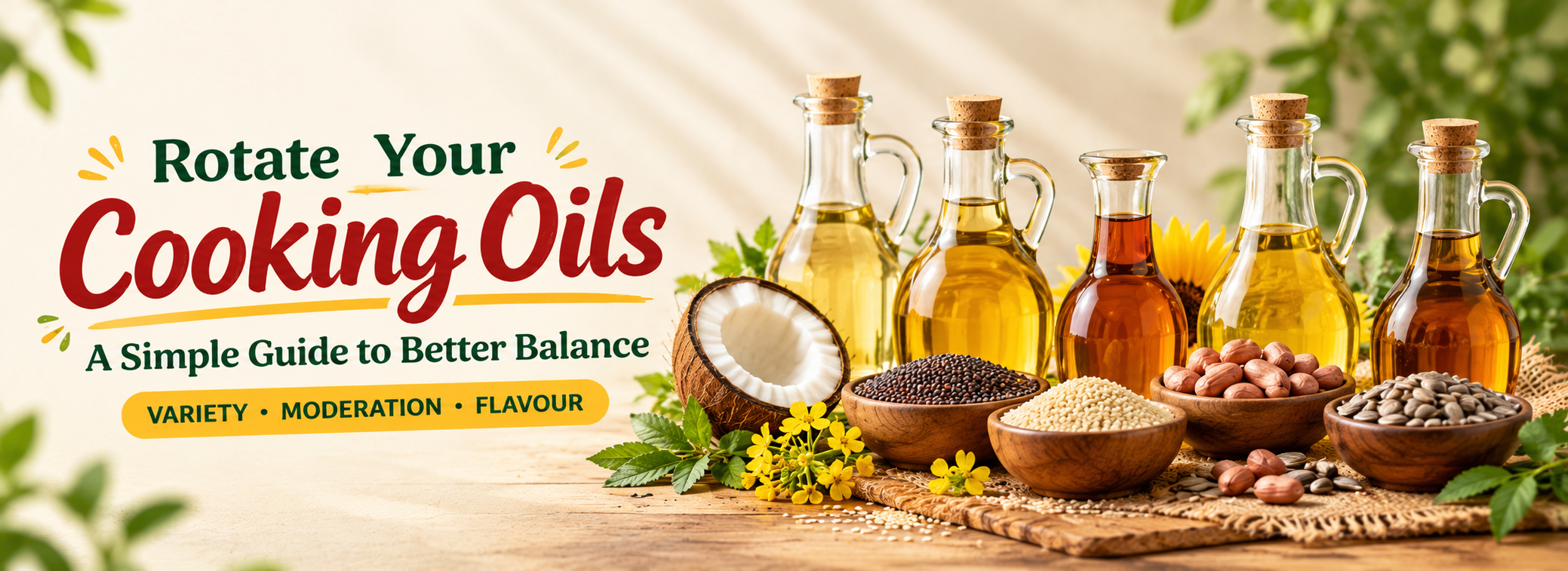
Quick answer: Rotating cooking oils can help you vary the types of fat you eat, which fits with Indian dietary guidance on variety. It isn’t a health shortcut, though. How much oil you use, how you cook, and what else is on your plate matter just as much. Treat rotation as a simple kitchen habit that supports balance, not as a guarantee.
If you’ve used the same bottle of oil for years, you’re in good company. Many Indian homes keep one oil for everything, from tadka to frying. This guide explains whether rotating cooking oils can support a more balanced diet, what the science does and doesn’t say, and how to rotate oils without making your kitchen complicated.
This is general food information, not medical advice. If you manage a health condition, talk to a doctor or registered dietitian about your oil choices.
What Does “Rotating Cooking Oils” Mean?
Rotating cooking oils means switching between different oils over days, weeks or seasons, instead of relying on one oil for every meal. You might use one oil for everyday sabzi, another for frying, and another for dishes where flavour matters most.
It isn’t a new idea. Traditional Indian kitchens already varied oils by region and dish. Coconut, mustard and sunflower oils are used for tempering in different parts of the country. onmanorama
Why Variety Matters: Different Oils, Different Fats
Saturated, monounsaturated and polyunsaturated fats in plain terms
All cooking oils are almost entirely fat. According to the ICMR-NIN’s “Facts and Fads of Lipids”, what separates one oil from another is the type of fat, not the amount. In simple terms: onmanorama
- Saturated fat (SFA): Eating too much over time can raise LDL (“bad”) cholesterol in many people, according to ICMR-NIN and WHO. onmanorama
- Monounsaturated fat (MUFA): Found in good amounts in oils such as groundnut and mustard.
- Polyunsaturated fat (PUFA): This group includes the essential omega-3 and omega-6 fatty acids, which our bodies cannot make on their own. onmanorama
How common Indian oils differ
No single oil is best at everything. A few examples from nutrition reporting:
- Coconut oil has more saturated fat than almost any other commonly used cooking oil, though ICMR-NIN doesn’t advise eliminating traditional oils. Portion size matters. onmanorama
- Groundnut oil has a good amount of monounsaturated fat and suits everyday cooking. onmanorama
- Sunflower oil is among the commonly used oils with the highest PUFA content. onmanorama
- A review in the Indian Heart Journal notes that mustard oil is rich in monounsaturated fat and also provides omega-3 fatty acids, a combination that is fairly uncommon among popular cooking oils. onmanorama
Because each oil has a different fatty-acid profile, using several over time spreads your intake across them instead of leaning heavily on one.
What Dietary Guidance Says About Oil Variety
Indian guidance supports variety, with a firm note about moderation:
- ICMR-NIN recommends using a variety of edible oils over time rather than depending entirely on one type, and notes that relying on a single oil for years may not give the best fatty-acid balance. onmanorama
- The 2024 Dietary Guidelines for Indians advise choosing a variety of oilseeds, nuts, nutricereals and legumes to meet daily fat and essential fatty acid needs. visionias
- The guidelines also stress using oils and fats in moderation, and consider seed oils acceptable for daily use. thesouthfirst
For a broader overview, see this summary of the Dietary Guidelines for Indians (2024). The sources I found give slightly different gram figures for daily visible fat, so check the official guidelines for the amount that suits your age, activity and health needs.
Can Rotating Cooking Oils Support a More Balanced Diet? What It Can and Can’t Do
Here is a fair summary.
What rotation can do:
- Spread your fat intake across different fatty-acid profiles.
- Help you match each oil to the dish and the cooking method.
- Make it easier to avoid using one oil for everything by default.
- Add flavour variety to everyday cooking.
What rotation can’t do:
- Make a heavy-oil diet balanced. Oil is calorie-dense whichever one you pick.
- Replace whole foods. Nuts, seeds, vegetables, pulses and whole grains also supply fats and nutrients.
- Guarantee a specific health outcome. I couldn’t find strong evidence that rotation alone improves health outcomes. It rests mostly on the variety principle in dietary guidance.
So the honest answer is: yes, rotating cooking oils can support a more balanced diet, as one small part of eating well, not as a fix on its own.
How to Rotate Cooking Oils at Home
You don’t need a rigid system. Pick whichever of these styles fits your kitchen.
Rotate by dish
Match oils to what you’re cooking. For example, a bolder oil for pickles and marinades, a milder one for daily sabzi, and coconut oil for coastal and South Indian dishes. Rotation then happens naturally as you cook different cuisines.
Rotate by week or bottle
If you prefer a simple rule, switch oils each week or each time a bottle finishes. Smaller bottles make this easy.
Rotate by season
Some families lean on certain oils in particular seasons or festivals. Keep it practical rather than strict.
A sample weekly rotation
| Use | Example oil choices | Why it fits |
| Everyday sabzi and dal tadka | Sunflower, safflower or groundnut | Mild flavour that lets the dish shine |
| Marinades, pickles, North and East Indian dishes | Mustard | Bold, pungent flavour |
| South Indian and coastal dishes | Coconut | Distinct flavour, traditional in these cuisines |
| Traditional dishes where aroma matters | Sesame | Strong, nutty aroma |
This is an example, not a prescription. Adjust it to your family’s taste and needs. For more on taste differences, see our guide to groundnut oil vs sesame oil.
Match the Oil to the Cooking Method
Rotation works best when each oil suits the job. Cold-pressed oils keep more of their natural flavour and colour because they aren’t extracted with high heat, while refined oils typically have a higher smoke point. Deep frying and other high-heat cooking generally call for an oil with a higher smoke point. twobrothersindiashoptwobrothersindiashop
In practice, that means using your more flavourful oils for tempering, sautéing and finishing, and choosing carefully for deep frying. Sources quote different smoke-point figures, so go by what your oil’s label and your cooking experience tell you, and don’t let oil smoke heavily. Our posts on the best cold-pressed oil for Indian cooking and which cold-pressed oil is best for cooking go deeper into tadka, frying and daily meals.
Storage and Reuse: Keep Each Oil in Good Condition
Rotating means keeping more than one bottle, so storage matters:
- Store oils away from heat, light and moisture. Here is why cooking oil should be kept away from heat and sunlight.
- Buy sizes you’ll finish in a reasonable time.
- Don’t keep reusing frying oil. FSSAI has set a limit of 25% Total Polar Compounds, beyond which vegetable oil should not be used. See the FSSAI used cooking oil (RUCO) page for details. fssai
- Frying less oil-heavy food helps too. Try these tips to reduce oil absorption while frying.
Common Mistakes When Rotating Oils
- Using more oil because you have more choices. Variety shouldn’t raise the total amount.
- Mixing leftover oils in one pan. Heat and storage needs differ between oils.
- Ignoring the label. Check the oil type, extraction method and FSSAI details. Our guide to how to identify pure cold-pressed oil explains what to look for.
- Switching based on trends. Choose oils you’ll actually enjoy and use up.
Frequently Asked Questions
Can rotating cooking oils support a more balanced diet?
Yes, it can support variety in the fats you eat, which aligns with ICMR-NIN’s advice to use a variety of oils over time. It works best alongside moderate oil use and a diet rich in whole foods.
How often should I switch cooking oils?
There’s no official schedule. Many people switch by dish, by week or when a bottle runs out. Choose whatever you can keep up easily.
Is it better to use one oil or several?
Guidance favours variety over depending entirely on one oil. Using a mix across dishes is a practical way to do that.
Can I mix two oils in the same dish?
You can, but many cooks prefer to use one oil per dish so flavour and heat behaviour are predictable.
Is cold-pressed oil better for rotation?
Cold-pressed oils retain more of the natural flavour and aroma of the seed, which many people enjoy in everyday cooking. Whichever you choose, use it in moderation and match it to your cooking method.
How much oil should I use daily?
It depends on your age, activity level and health needs. Refer to the ICMR-NIN Dietary Guidelines or ask a dietitian for a figure that suits you.
Should people with health conditions rotate oils?
Speak to your doctor or dietitian first. This article is general information, not medical advice.
Start Your Own Oil Rotation with Khomane Agro
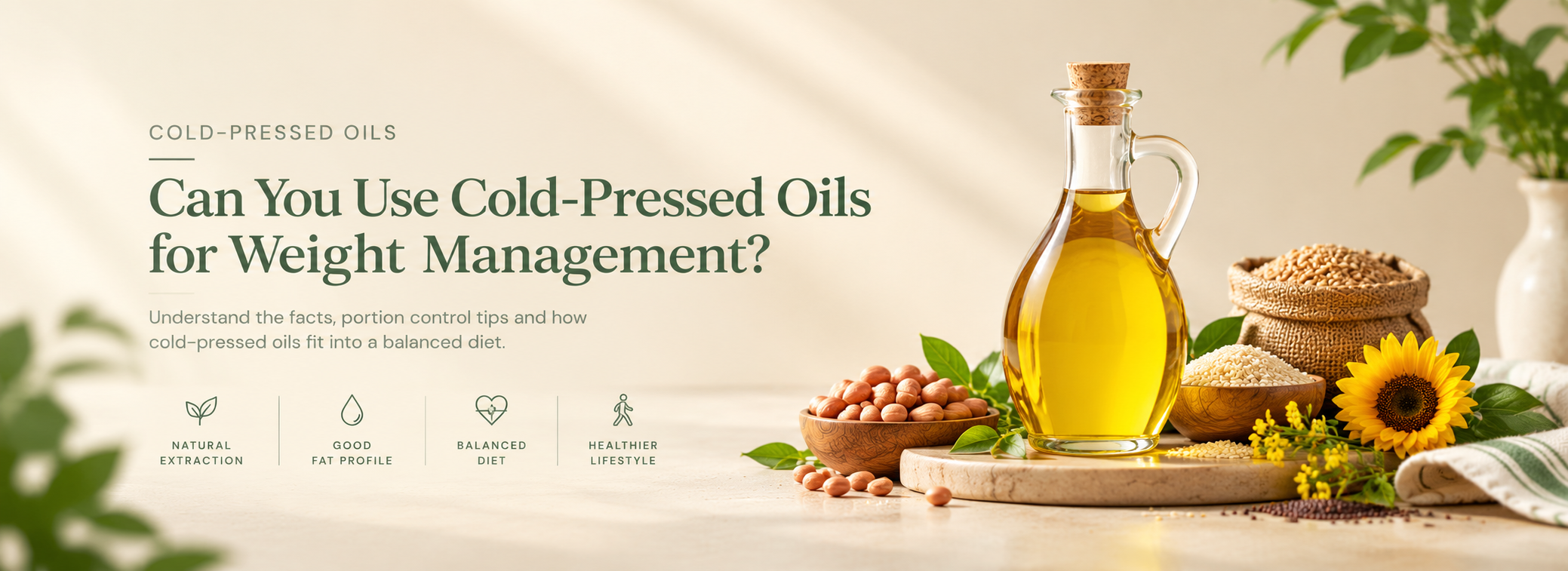
If you’d like to try rotating cooking oils, you can build a simple set from Khomane Agro’s range of cold-pressed oils, including mustard oil, sunflower oil, safflower oil, coconut oil and sesame oil. Start with two or three bottles, match each to the dishes you cook most, and see what suits your family.
Ready to order or have questions? Get in touch with Khomane Agro Farmer Producer Company Limited:
- Shop online: khomaneagro.com/shop
- WhatsApp: 087673 06068
- Email: khomaneagrofpc@gmail.com
- Address: Gat No – 498, Korhale Budruk, Baramati, Maharashtra 412103
Bulk, distributor and export enquiries are also welcome.