Buying cooking oil online is not the same as picking a bottle off a supermarket shelf. You cannot smell it, feel its texture, or ask the shopkeeper where it came from. All you have is a product photo, a description, and a set of claims that may or may not be accurate.
This is exactly why so many online buyers struggle to tell genuine cold-pressed oil apart from ordinary refined oil dressed up in attractive packaging. Words like “natural,” “premium,” and “farm-fresh” look reassuring on a label, but none of them are proof of purity on their own.
If you’re wondering how to identify pure cold-pressed oil before adding it to your cart, the good news is that you don’t need a lab to make an informed decision. You need to know what to look for. This guide walks you through a practical 10-point checklist — covering labels, extraction methods, packaging, aroma, and brand transparency — so you can buy with confidence.
How Can You Identify Pure Cold-Pressed Oil Before Buying Online?
To identify pure cold-pressed oil online, check the ingredient list, extraction method, and FSSAI licence details on the label. Look for a clear manufacturing date, batch number, and tamper-evident packaging. Natural aroma and colour can offer clues, but they vary by seed type, so they should never be the only test. Choose brands that are transparent about their raw-material source, farmer sourcing, and manufacturing process, and that provide accessible customer support.
What Does Pure Cold-Pressed Oil Mean?
Cold pressing is a mechanical extraction method where oilseeds are crushed at low speed and low temperature, without the use of chemical solvents or high heat. This is different from conventional refining, where oil is extracted using heat, solvents like hexane, and further chemical processing to remove colour, odour, and impurities.
Because cold pressing avoids high heat, the oil generally retains more of the seed’s natural colour, aroma, and nutrients compared to refined oil. However, “cold pressed” is a specific process claim, not a marketing adjective. The same applies to “wood pressed” or “kachi ghani,” which describe traditional extraction using a wooden or stone crusher (ghani).
These terms should not be treated as interchangeable unless the seller clearly explains the actual process used. A label that simply says “pure” or “natural” without describing the extraction method does not tell you much. Genuine cold-pressed and wood-pressed oils will usually mention:
- The extraction method by name (cold pressed, wood pressed, mechanically expelled)
- Whether the oil is filtered or unfiltered
- Whether any refining step was used afterward
If this information is missing, it’s worth asking the seller directly before you buy.
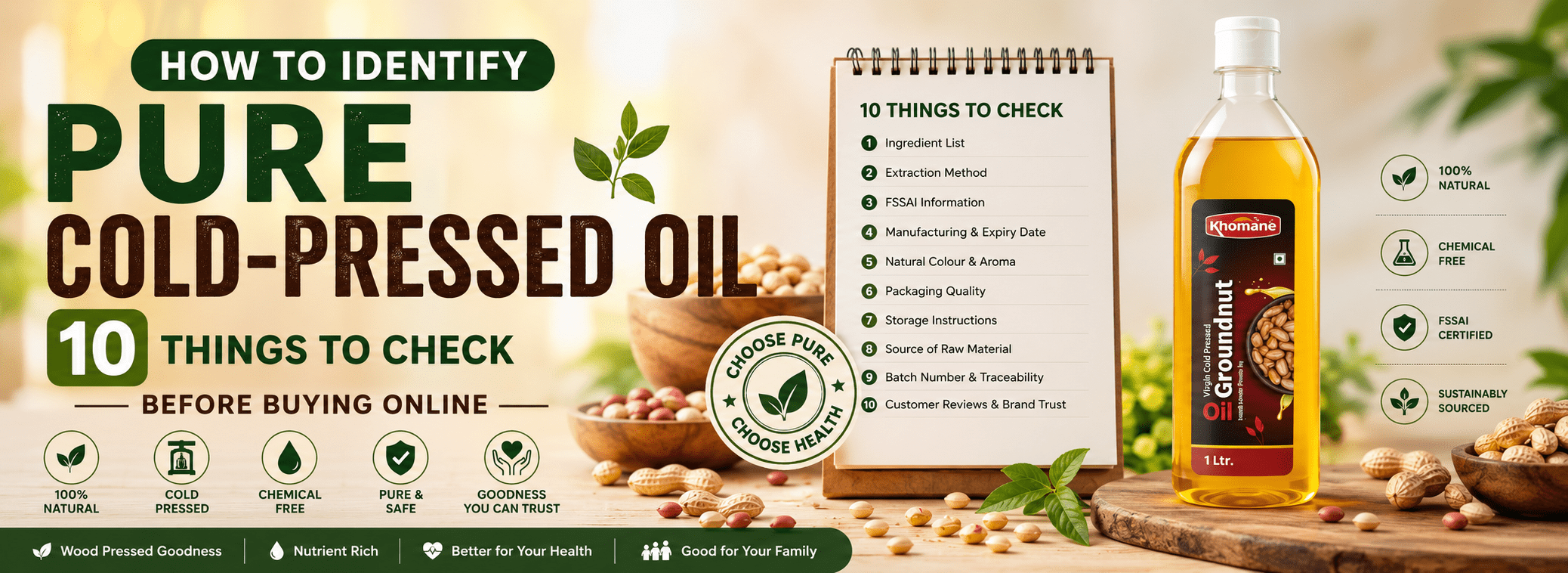
10 Things to Check Before Buying Pure Cold-Pressed Oil Online
1. Check the Ingredient List
A trustworthy cold-pressed oil label should clearly state the single source ingredient — for example, “100% groundnut” or “mustard seed oil” — rather than a vague description like “vegetable oil” or “edible oil blend.” If the ingredient list is unclear or mixes multiple oils without explanation, treat it as a warning sign.
2. Verify the Extraction Method
Look for specific terms such as cold pressed, mechanically extracted, wood pressed, filtered, or refined. Each term describes a different process, and the label should specify which one applies. Avoid products that only use generic words like “pure” or “premium” without any process detail.
3. Check FSSAI Information
Every legally sold food product in India, including cooking oil, should carry FSSAI compliance details. Before buying, check for:
- FSSAI licence number
- Manufacturer’s name
- Registered address
- Customer-care contact details
- Other legally required declarations (net weight, MRP, vegetarian symbol, etc.)
You can also learn more about food safety standards directly from the Food Safety and Standards Authority of India (FSSAI).
4. Check the Manufacturing and Best-Before Dates
Freshness matters for cold-pressed oil since it typically contains fewer preservatives than heavily refined oil. Always check the manufacturing date and best-before date before purchase, and avoid products where this information is missing, unclear, or looks tampered with.
5. Observe the Natural Colour and Aroma
Cold-pressed oils often have a more noticeable natural colour and aroma than refined oils, but this varies significantly by oilseed, harvest, and filtration level. A strong or mild smell alone does not confirm purity — it should be considered alongside other checks, not in isolation.
6. Review the Packaging
Good packaging protects oil quality and indicates that the seller has taken quality control seriously. Look for:
- Sealed, leak-proof packaging
- Tamper-evident caps or seals
- Food-grade containers
- Protection from direct heat and light (opaque or dark bottles are often preferred)
- A clearly readable label
7. Read the Storage Instructions
Heat, direct sunlight, air exposure, and moisture can all degrade oil quality over time, regardless of how it was extracted. Check whether the label includes storage guidance, such as keeping the container tightly closed and away from direct sunlight or heat sources.
8. Check the Source of Raw Material
Where the seeds come from matters. Brands that can speak to their raw-material sourcing — whether from a specific farming region, a farmer cooperative, or a traceable supply chain — generally offer more transparency than those with no sourcing information at all.
9. Look for the Batch Number and Traceability Details
A batch number allows a manufacturer to trace a specific production run, which is useful for quality control and for resolving any customer complaints. Its absence doesn’t automatically mean a product is fake, but its presence is a positive sign of organised, accountable manufacturing.
10. Evaluate Brand Transparency
Before purchasing, spend a few minutes reviewing the brand itself. Check their About Us page, factory or manufacturing information, contact details, return or replacement policy, customer reviews, and whether product images look genuine or generic. A brand that is open about its process typically has nothing to hide.
Quick Reference: 10-Point Purity Checklist
| Check | What to Look For | Warning Sign |
|---|---|---|
| Ingredient list | Single, clearly named oil source | Vague terms like “edible oil” |
| Extraction method | Cold pressed, wood pressed, mechanically extracted | No process mentioned at all |
| FSSAI information | Licence number, manufacturer address, contact details | Missing or unverifiable FSSAI details |
| Manufacturing/best-before date | Recent date, clear shelf-life | Faded, missing, or altered dates |
| Colour and aroma | Natural variation explained | Claims that smell alone “proves” purity |
| Packaging | Sealed, tamper-evident, food-grade | Broken seal, flimsy or leaking container |
| Storage instructions | Clear guidance on heat/light/moisture | No storage information provided |
| Raw material source | Named region or traceable sourcing | No sourcing information |
| Batch number | Present and traceable | No batch or lot number |
| Brand transparency | Active About Us, factory details, support | Generic images, no contact information |
Cold-Pressed Oil vs Refined Oil
| Factor | Cold-Pressed Oil | Refined Oil |
|---|---|---|
| Extraction method | Mechanical pressing, low heat | Heat and/or solvent extraction |
| Heat exposure | Minimal | High |
| Processing | Minimal, sometimes unfiltered or lightly filtered | Multiple refining stages (degumming, bleaching, deodorising) |
| Aroma | Often more pronounced, varies by seed | Typically neutral or mild |
| Colour | Naturally varies (golden, amber, greenish) | Usually lighter and more uniform |
| Additives | Generally none, unless stated | May include anti-foaming or other permitted additives |
| Filtration | Ranges from unfiltered to lightly filtered | Extensively filtered |
| Shelf life | Often shorter without added stabilisers | Generally longer due to processing |
| Cooking usage | Suited to many everyday Indian dishes | Widely used across households and food service |
| Label transparency | Should specify process clearly | Should also specify process clearly |
Neither category is universally “better” for every person or every use. The right choice depends on your cooking needs, budget, and personal preference. What matters most is that the label accurately reflects what is inside the bottle.
Does Pure Cold-Pressed Oil Have a Strong Smell?
Not necessarily. Aroma depends on the oilseed used, how fresh the oil is, how it was filtered, how it was stored, and the exact extraction process — not on purity alone.
For example, mustard oil is known for a naturally pungent aroma, while groundnut oil tends to have a mild, nutty smell. Coconut oil carries its familiar distinct fragrance, and sunflower or safflower oils are often comparatively mild. A weak smell in a mild-aroma oil like sunflower is not automatically a red flag, just as a strong smell in mustard oil is not automatic proof of purity. Aroma is one data point among several, not a stand-alone test.
Is Sediment in Cold-Pressed Oil Normal?
In some minimally filtered cold-pressed oils, small natural particles or a light haze can appear, especially in colder weather. This is not, by itself, a sign of purity or impurity — it largely reflects how much the oil was filtered after extraction.
That said, sediment is not something to ignore either. Excessive particles, an unusual or rancid odour, foaming, or visible leakage from the packaging can indicate poor handling, contamination, or storage issues, and should be treated as a genuine warning sign rather than a “natural” quirk.
What Packaging Is Best for Cold-Pressed Oil?
The best packaging for cold-pressed oil is sealed, leak-proof, and made of food-grade material that limits exposure to light and heat. Glass or opaque food-grade plastic containers with tamper-evident caps are commonly preferred, since both light and heat can gradually affect oil quality over time.
How Can You Verify a Cold-Pressed Oil Brand Online?
You can verify a brand by checking its About Us page, factory or sourcing information, FSSAI details, contact information, and return policy. Genuine product photography, responsive customer support, and consistent information across the website are also good indicators of a legitimate business.
What Are the Warning Signs of Poor-Quality Cooking Oil?
Common red flags when buying cold-pressed oil online include:
- No FSSAI licence details displayed
- Missing manufacturer name or address
- Vague or unclear ingredient list
- Price that seems unusually low compared to similar products
- No batch number or manufacturing date
- Exaggerated or misleading health claims
- Generic stock images instead of real product photos
- No accessible contact information
- Product descriptions that appear copied from other listings
- Broken or missing tamper-evident seals
- Unclear or absent return/replacement policy
If a listing shows several of these signs together, it’s worth pausing before you buy.
How to Check Cold-Pressed Oil Quality After Delivery
Once your order arrives, a quick post-delivery check can help confirm you received what you ordered:
- Inspect the seal for any damage or signs of tampering
- Match the product with your order invoice
- Check the manufacturing date printed on the label
- Note down the batch number for future reference
- Check for any leakage in the packaging
- Smell the oil and note if it matches the expected aroma for that oil type
- Observe the consistency and colour
- Verify that customer-care information on the label is accurate
- Store the oil correctly right away, away from heat and direct sunlight
How Khomane Agro Supports Product Transparency
At Khomane Agro, product transparency is treated as a core part of building customer trust, not an afterthought. Buyers are encouraged to look for clear product labels, oil type, extraction information, FSSAI details, batch number, manufacturing date, and storage instructions on every product listing before purchase.
Khomane Agro’s approach centres on connecting its cold-pressed oil collection back to its farmer network and manufacturing process, so that customers can understand where their oil comes from rather than relying on marketing language alone.
[Insert verified extraction process] [Insert verified farmer-sourcing details] [Insert verified factory or processing information] [Insert actual FSSAI details] [Insert real product packaging image] [Insert genuine factory photograph] [Insert verified quality-control process]
To see this in practice, you can explore Khomane Agro’s complete cold-pressed oil collection, visit the Factory Tour page to understand the manufacturing process, or read the About Us page to learn more about the farmer network behind the brand. Individual product pages for cold-pressed groundnut oil, cold-pressed sunflower oil, cold-pressed safflower oil, cold-pressed mustard oil, and cold-pressed coconut oil list the details covered in this guide, so you can apply the same checklist directly while browsing.
Frequently Asked Questions
1. How can I identify pure cold-pressed oil? Check the ingredient list, extraction method, FSSAI licence details, manufacturing date, batch number, and packaging quality. Natural aroma and colour can offer supporting clues, but should not be used as the sole test, since they vary by seed type and processing.
2. What should I check on a cold-pressed oil label? Look for the oil source, extraction method, FSSAI licence number, manufacturer address, manufacturing and best-before dates, batch number, and storage instructions. A complete, clearly written label is one of the strongest indicators of a transparent brand.
3. Does pure cold-pressed oil have a strong smell? Not always. Aroma depends on the oilseed, freshness, filtration, and storage. Mustard oil is typically more pungent, while sunflower or safflower oils tend to be milder, so smell alone cannot confirm purity.
4. Is darker cold-pressed oil always better? No. Colour varies naturally with seed variety, harvesting season, and filtration level. A darker or lighter shade does not, by itself, indicate better or worse quality.
5. Is sediment in cold-pressed oil normal? Minor sediment can occur in minimally filtered oils and is not automatically a purity issue. However, excessive particles, rancid smell, or foaming should be treated as warning signs, not normal variation.
6. What is the difference between refined and cold-pressed oil? Cold-pressed oil is extracted mechanically at low temperatures without solvents, while refined oil undergoes heat and/or chemical processing to remove colour, odour, and impurities. Both should be clearly labelled with their extraction process.
7. Can cold-pressed oil be used for Indian cooking? Yes, cold-pressed oils such as groundnut, mustard, sunflower, safflower, and coconut oil are commonly used across various Indian cooking styles, from tempering and sautéing to traditional regional recipes.
8. How should cold-pressed oil be stored? Store it in a cool, dry place away from direct sunlight and heat, with the container tightly sealed after each use. Proper storage helps maintain aroma, colour, and overall quality over time.
9. How long does cold-pressed oil last after opening? Shelf life varies by oil type, filtration, and storage conditions, so it’s best to check the best-before date on the label and follow the manufacturer’s storage instructions rather than assuming a fixed duration.
10. Where can I buy genuine cold-pressed oil online? Look for brands that display complete labelling, FSSAI details, batch numbers, and transparent sourcing information, such as Khomane Agro’s cold-pressed oil collection, and always review product details before ordering.
Conclusion
Learning how to identify pure cold-pressed oil doesn’t require special equipment — it requires knowing where to look. Checking the ingredient list, extraction method, FSSAI details, manufacturing date, batch number, packaging, and brand transparency together gives you a far more reliable picture than judging a product by colour, smell, or sediment alone.
It’s worth remembering that home observations have limits. Laboratory testing remains the most reliable way to confirm oil purity with certainty, and no single visual or aroma test can substitute for that. What buyers can control is choosing a brand that is upfront about its labelling, sourcing, and manufacturing process, and that makes this information easy to find.
Explore Khomane Agro’s complete cold-pressed oil collection and review the product details, packaging information, available sizes, and recommended uses before placing your order.