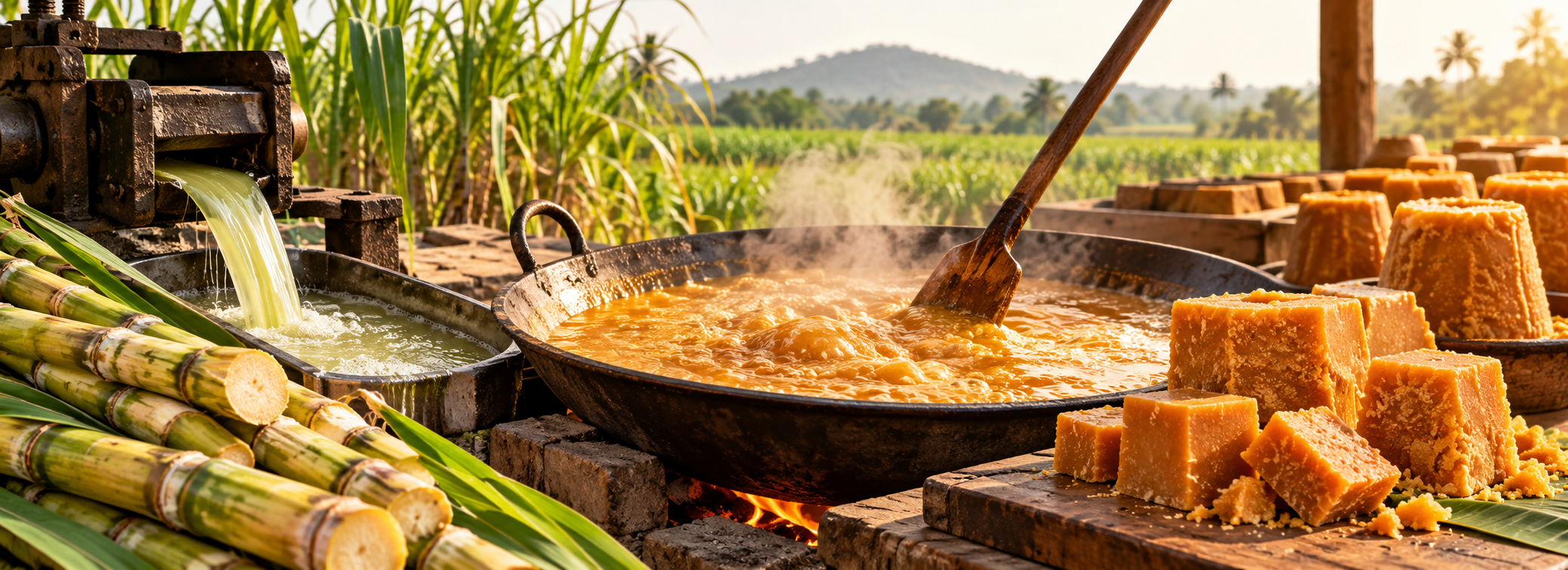
Jaggery is made from sugarcane by extracting fresh sugarcane juice, filtering it, boiling the juice to remove excess water, concentrating it into a thick syrup, and then cooling the syrup in moulds until it solidifies into gud.
Unlike highly refined white sugar, traditional jaggery undergoes comparatively fewer processing stages. This simple sugarcane-to-gud process is responsible for jaggery’s characteristic golden-brown colour, rich aroma and distinctive taste.
Known as gud in Hindi and gul in Marathi, jaggery has been used in Indian households for generations. It is commonly added to sweets, beverages, traditional recipes and everyday foods.
But how does fresh sugarcane growing in a field become the solid jaggery blocks, powder or bites available in stores?
Here is the complete jaggery making process from sugarcane to gud, explained step by step.
How Is Jaggery Made from Sugarcane?
The traditional jaggery production process generally involves six main stages:
- Harvesting sugarcane
- Extracting sugarcane juice
- Filtering and clarifying the juice
- Boiling and concentrating the juice
- Cooling and moulding the jaggery
- Cutting, packing and storing the finished gud
Each stage can influence the colour, flavour, texture and overall quality of the finished jaggery.
Step 1: Harvesting Fresh Sugarcane
The journey of jaggery begins in the sugarcane field.
Mature sugarcane is harvested once it reaches an appropriate stage for processing. The harvested stalks are transported to the jaggery production area, where they are prepared for crushing.
The quality of the raw sugarcane is important because the jaggery making process starts with the sugarcane juice itself.
Factors such as sugarcane variety, maturity, freshness and storage conditions can influence the juice and, ultimately, the finished gud.
Step 2: Extracting Sugarcane Juice
After harvesting, the sugarcane stalks are passed through a crusher or roller system.
The pressure from the rollers extracts the naturally sweet juice contained inside the sugarcane.
This freshly extracted sugarcane juice becomes the primary raw material used for making jaggery.
The fibrous material remaining after crushing is commonly known as bagasse.
At this stage, the juice may contain:
- Small sugarcane fibres
- Dirt or field residue
- Suspended particles
- Natural plant matter
These impurities need to be removed before the juice is concentrated.
Step 3: Filtering the Sugarcane Juice
The extracted sugarcane juice is filtered before boiling.
Filtering helps remove larger pieces of bagasse, dirt and other unwanted particles that may have entered the juice during crushing.
Proper filtration is an important part of the sugarcane-to-jaggery process because cleaner juice helps produce a more consistent finished product.
After filtration, the juice is transferred to large boiling pans.
Step 4: Boiling Sugarcane Juice in Large Pans
Boiling is one of the most important stages in understanding how jaggery is made.
The filtered sugarcane juice is heated in large, usually shallow pans. As the juice heats, its water content gradually evaporates.
The liquid becomes increasingly concentrated as boiling continues.
During this stage, the jaggery maker closely monitors:
- Temperature
- Thickness
- Colour
- Foam formation
- Consistency of the syrup
- Boiling time
The mixture must also be stirred and monitored carefully to help prevent scorching and uneven heating.
Gradually, the thin sugarcane juice transforms into a thick, concentrated syrup.
Step 5: Clarifying the Sugarcane Juice
As sugarcane juice boils, foam and impurities may rise to the surface.
These are removed during the clarification process.
Traditional jaggery-making practices may use suitable clarification methods to help separate suspended impurities from the boiling juice.
The purpose of clarification is to achieve a cleaner syrup while preserving the characteristic colour and flavour associated with jaggery.
The exact process can vary between jaggery producers and regions.
Step 6: Concentrating the Juice into Thick Jaggery Syrup
As more water evaporates, the sugar concentration increases and the juice becomes progressively thicker.
This stage requires considerable experience.
If the syrup is removed too early, the resulting jaggery may contain too much moisture and fail to set properly.
If it is heated for too long, the flavour, colour and texture can also change.
Experienced jaggery makers therefore judge when the concentrated syrup has reached the appropriate consistency for moulding.
This transition from liquid sugarcane juice to concentrated syrup is one of the most important stages of the traditional jaggery making process.
Step 7: Cooling and Moulding the Jaggery
Once the syrup reaches the required consistency, it is removed from the heat and transferred for cooling.
The hot jaggery syrup is poured into moulds or cooling trays.
As the temperature falls, the concentrated syrup begins to solidify.
Depending on the intended product, jaggery can be prepared in several forms, including:
- Jaggery blocks
- Jaggery cubes
- Jaggery powder
- Small jaggery bites
- Flavoured jaggery products
The cooling and moulding stage gives the gud its final shape and texture.
Step 8: Cutting and Packaging the Gud
Once completely cooled and solidified, the jaggery is removed from the moulds.
Larger blocks may be cut into smaller portions before packaging.
Proper packaging helps protect jaggery from excessive moisture, dust and outside contamination during transportation and storage.
The finished product is then ready to travel from the jaggery production unit to homes, shops and online customers.
Sugarcane to Jaggery Process at a Glance
For anyone looking for a simple answer to how gud is made, the process can be summarised as:
Sugarcane → Crushing → Juice Extraction → Filtration → Boiling → Clarification → Concentration → Cooling → Moulding → Packaging
In simple terms, jaggery is produced mainly by removing water from sugarcane juice until the natural sugars become concentrated enough to solidify.
Why Is Jaggery Brown Instead of White Like Refined Sugar?
Jaggery normally appears golden, light brown or dark brown because it is not processed in exactly the same way as refined white sugar.
During conventional sugar refining, several stages are used to separate and purify the sucrose crystals.
Traditional jaggery retains more of the sugarcane syrup components responsible for its colour, aroma and distinctive flavour.
The exact shade of jaggery can vary depending on:
- Sugarcane quality
- Juice composition
- Boiling conditions
- Heating duration
- Clarification process
- Moisture level
- Production method
Therefore, jaggery does not always need to have exactly the same colour to be genuine.
What Determines the Quality of Jaggery?
Producing good-quality jaggery involves much more than simply boiling sugarcane juice.
Several factors can influence the final product.
1. Quality of Sugarcane
Fresh, appropriately mature sugarcane provides the foundation for good jaggery.
2. Clean Juice Extraction
Clean crushing and filtration help minimise unwanted fibres and impurities.
3. Controlled Boiling
Proper control of temperature and heating time can affect colour, taste and consistency.
4. Proper Clarification
Careful removal of foam and suspended impurities contributes to a cleaner finished product.
5. Correct Moisture Level
Excess moisture can affect the texture and storage quality of jaggery.
6. Hygienic Handling and Packaging
Clean processing, cooling and packaging conditions are important for maintaining overall product quality.
Traditional Jaggery vs Refined Sugar: How Is the Processing Different?
Both jaggery and sugar can begin with sugarcane juice, but their production processes differ considerably after extraction.
Traditional jaggery is generally produced by filtering and concentrating sugarcane juice before allowing it to cool and solidify.
Refined sugar undergoes additional industrial processing to isolate and crystallise sucrose and produce the familiar white sugar crystals.
Because jaggery undergoes a different level and type of processing, its colour, texture and flavour remain different from refined sugar.
This is why many consumers searching for less processed sweetener options consider traditional gud for use in Indian recipes.
However, jaggery is still primarily a source of sugar and should be consumed accordingly.
Handmade vs Machine-Made Jaggery
The basic principle behind jaggery production remains similar whether the process uses traditional equipment or more mechanised systems.
Both generally involve:
Juice extraction → filtration → boiling → concentration → cooling → packaging
The difference is largely in the equipment and level of automation used at different stages.
Traditional or small-batch production may rely more heavily on manual monitoring, while larger manufacturing facilities may use machinery to improve consistency, handling and production capacity.
Ultimately, factors such as raw-material quality, process control, hygiene and proper storage are more useful indicators of product quality than simply whether a process is described as handmade or machine-made.
What Forms of Jaggery Are Available?
Modern consumers can purchase jaggery in several convenient formats.
Jaggery Blocks
Traditional solid gud that can be broken or grated depending on the recipe.
Jaggery Powder
Powdered jaggery is convenient for tea, beverages, sweets and everyday cooking because measuring and mixing it is easier.
Jaggery Bites
Smaller ready-to-use portions offer convenient serving sizes.
Flavoured Jaggery
Jaggery can also be combined with selected ingredients and flavours to create convenient after-meal or snacking varieties.
At Khomane Agro Farmer Producer Company Limited, customers can explore different jaggery formats depending on their cooking and consumption preferences.
Is Jaggery More Natural Than Refined Sugar?
Jaggery is commonly described as a less refined form of sugar because traditional production concentrates sugarcane juice without converting it into highly refined white sugar crystals.
However, “natural” should not be interpreted as meaning unlimited consumption is advisable.
Jaggery remains a sugar-rich food.
Its primary advantage from a processing perspective is that the traditional sugarcane-to-gud process involves fewer refining stages than conventional white sugar production.
Where Is Jaggery Commonly Produced in Maharashtra?
Sugarcane-growing regions of Maharashtra have a long connection with jaggery production.
Areas surrounding Baramati and other agricultural regions of Maharashtra have access to sugarcane cultivation and farming communities that support agricultural processing businesses.
Khomane Agro Farmer Producer Company Limited is located at Korhale Budruk, Baramati, Maharashtra, connecting its food products with an agricultural production region.
For consumers searching online for jaggery from Maharashtra, understanding the origin and production process can help them make a more informed purchase.
How Can You Use Jaggery at Home?
Jaggery is commonly used across Indian households in both traditional and everyday recipes.
Popular uses include:
- Tea and beverages
- Laddus and traditional sweets
- Puran Poli
- Chikki
- Kheer
- Modak
- Sesame and peanut preparations
- Homemade desserts
- Chutneys
- Regional Maharashtrian recipes
Powdered jaggery can be particularly convenient for recipes where quick mixing or accurate measuring is required.
Frequently Asked Questions About How Jaggery Is Made
How is jaggery made from sugarcane?
Jaggery is made by crushing sugarcane to extract its juice, filtering the juice, boiling it until most of the water evaporates, concentrating it into a thick syrup and finally cooling the syrup in moulds until it solidifies.
What is jaggery made from?
In India, jaggery is commonly made from sugarcane juice. Jaggery can also be produced from other plant sources in some regions, but sugarcane jaggery is among the most widely consumed varieties.
What is the difference between jaggery and gud?
There is no fundamental difference. Gud is a commonly used Hindi term for jaggery, while gul is commonly used in Marathi.
Is jaggery made directly from sugarcane juice?
Yes. Sugarcane jaggery starts with freshly extracted sugarcane juice. The juice is filtered, heated, concentrated and cooled until it becomes solid jaggery.
Is jaggery refined like white sugar?
No. Traditional jaggery does not undergo the same extensive refining and crystallisation process used to produce white table sugar.
Why does jaggery have a brown colour?
Jaggery retains components of concentrated sugarcane juice that contribute to its golden-to-brown colour. The exact colour can vary depending on the sugarcane and processing conditions.
Why does jaggery colour vary between batches?
Variations in sugarcane, boiling temperature, heating duration, clarification and moisture can affect the final colour of jaggery.
Does jaggery require preservatives?
Traditionally prepared jaggery can be produced without adding preservatives. Storage stability depends on factors such as moisture, packaging and storage conditions, so consumers should always follow the manufacturer’s storage instructions.
How should jaggery be stored?
Jaggery should generally be kept in a clean, dry, airtight container away from excessive moisture and direct heat. Always follow any storage instructions printed on the product packaging.
Which type of jaggery is best for everyday cooking?
The best format depends mainly on the recipe and convenience required. Jaggery blocks are suitable for traditional preparation, while jaggery powder can be easier to measure, mix and dissolve.
From Sugarcane Fields to Your Kitchen
The process of making jaggery may look simple, but every stage—from selecting sugarcane and extracting juice to controlling the boiling temperature and determining the correct consistency—can influence the finished product.
Understanding how jaggery is made from sugarcane makes it easier to appreciate the journey behind every block, spoonful or bite of gud.
At Khomane Agro Farmer Producer Company Limited, our focus is on bringing farm-connected food products from Maharashtra to consumers looking for authentic everyday foods.
Explore our range of jaggery products, including different formats suitable for cooking, sweets and everyday use.
👉 Shop Khomane Agro’s Jaggery Range:
https://khomaneagro.com/product-category/jaggery/jaggery-gud/
About Khomane Agro Farmer Producer Company Limited
Khomane Agro Farmer Producer Company Limited is based in Korhale Budruk, Baramati, Maharashtra, and offers agricultural and food products for customers looking for farm-connected Indian food options.
Address: Gat No. 498, Korhale Budruk, Baramati, Maharashtra – 412103
Email: khomaneagrofpc@gmail.com
Phone: 08767306068