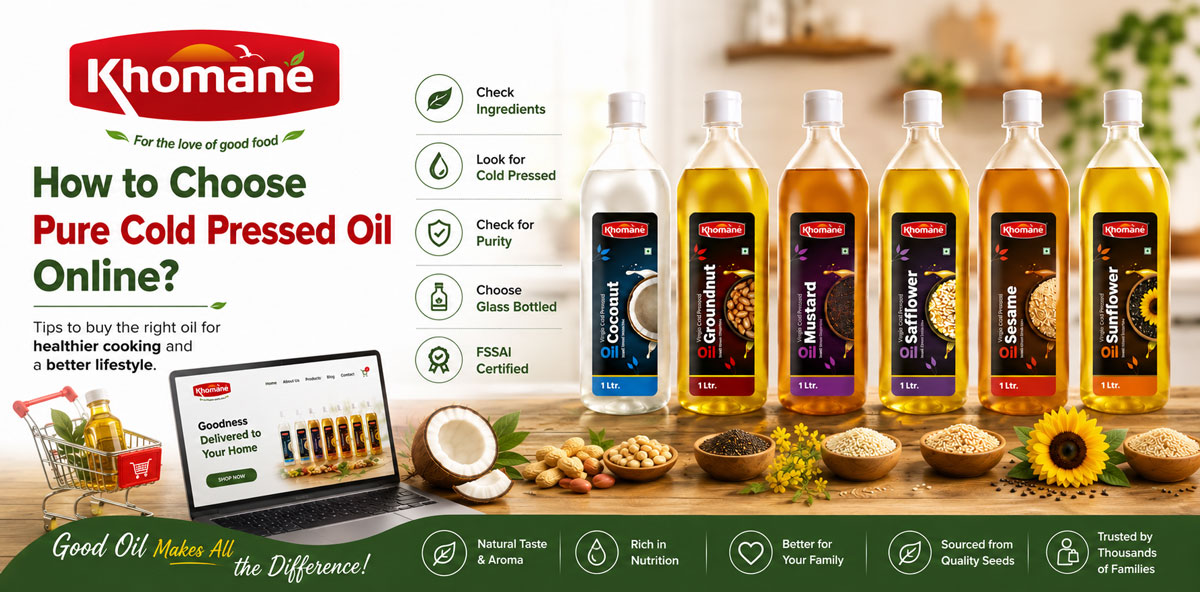
How to Choose Pure Cold-Pressed Oil Online Without Being Misled
Buying pure cold-pressed oil online should feel straightforward. However, with countless products claiming to be “natural,” “traditional,” “wood-pressed,” or “100% pure,” identifying genuinely suitable cooking oil can become confusing. Packaging may look convincing, but the real answers lie in the ingredients, processing details, freshness, seller transparency and product information.
Whether you are looking for cold-pressed groundnut oil, sesame oil, coconut oil or mustard oil, understanding what to check before placing an order can help you make a more informed choice.
This cold-pressed oil buying guide explains how to evaluate products online, recognise misleading claims and select the right oil for your kitchen.
What Is Cold-Pressed Oil?
Cold-pressed oil is extracted by mechanically pressing oil-bearing seeds, nuts or fruits. Unlike heavily refined oils, cold-pressed varieties generally undergo less intensive processing, allowing them to retain more of their natural aroma, colour and characteristic flavour.
Common examples include:
- Cold-pressed groundnut oil
- Cold-pressed sesame oil
- Cold-pressed coconut oil
- Cold-pressed mustard oil
- Cold-pressed sunflower oil
The final product can vary in appearance and taste depending on the raw ingredients, extraction method, filtration and storage conditions.
However, the phrase “cold-pressed” on its own does not establish product quality. Buyers still need to review the label and verify whether the brand provides clear, credible product information.
Why Buying Pure Cold-Pressed Oil Online Can Be Confusing
Online marketplaces offer convenience, but they can also make products appear more similar than they actually are.
A bottle may include attractive phrases such as:
- “Farm fresh”
- “Traditional extraction”
- “Natural oil”
- “Wood-pressed”
- “Premium quality”
- “100% authentic”
These descriptions are useful only when supported by accurate ingredient lists, transparent production details and proper labelling.
For example, an oil described as “traditional” may still be a blend. Similarly, a product packaged in an attractive glass bottle is not automatically fresher or purer than one sold in another food-safe container.
When you buy cold-pressed oil online, the goal should be to verify the product rather than rely only on marketing language.
10 Things to Check Before Buying Pure Cold-Pressed Oil Online
1. Read the Ingredient List Carefully
The ingredient list is one of the most important indicators of what you are actually buying.
For a single-source oil, the label should clearly identify the ingredient.
Examples:
- Groundnut oil
- Sesame oil
- Coconut oil
- Mustard oil
If the product contains multiple oils, the label should identify the blend.
A bottle sold as cold-pressed groundnut oil should not leave you guessing whether it contains groundnut oil alone or a combination of different edible oils.
Before ordering, look for:
- Clear identification of the oil source.
- An ingredient list that matches the product name.
- Transparent disclosure if the product is a blend.
- No vague substitution of specific ingredients with broad marketing claims.
A single-ingredient label can be a positive sign, but it should still be considered alongside freshness, traceability and seller credibility.
2. Look for Clear Information About the Extraction Process
If a company claims to sell pure cold-pressed cooking oil, it should explain how the oil is produced.
Useful product descriptions may include information about:
- Mechanical extraction.
- The seed, nut or fruit used.
- Whether the oil is filtered.
- Whether the product is refined or unrefined.
- Batch production or sourcing practices.
Be cautious when the listing repeatedly claims “cold-pressed” but provides no additional information about the product or its processing.
Transparent brands generally make it easier for customers to understand what they are purchasing.
Is Wood-Pressed Oil the Same as Cold-Pressed Oil?
Not necessarily.
“Wood-pressed” usually refers to oil extracted using equipment that incorporates a wooden press. “Cold-pressed” generally describes mechanical extraction without the intensive refining associated with many conventional oils.
These terms can overlap, but one does not automatically prove the other.
If a product claims to be wood-pressed, check whether the seller also explains the actual extraction method and other relevant production details.
3. Check the Manufacturing and Best-Before Dates
Freshness matters when buying natural cooking oil.
Oils can gradually lose quality through exposure to heat, light and oxygen. Over time, poor storage may affect their aroma and flavour.
Before ordering, look for:
- Manufacturing or packing date.
- Best-before information.
- Batch identification.
- Storage instructions.
If these details are not visible on the online listing, review the product images or ask the seller before purchasing.
A genuinely fresh product should have a clear timeline that allows you to make an informed decision.
How Much Cold-Pressed Oil Should You Buy?
Choose a pack size that matches your household’s cooking habits.
For example:
- Smaller bottles suit first-time buyers or occasional use.
- Medium-sized packs work well for regular household cooking.
- Larger packs may be practical for families that use the same oil consistently.
Buying a large quantity only makes sense if you can store it properly and use it within the recommended period.
4. Verify Food-Labelling and Business Details
A credible edible-oil product should provide clear information about the business responsible for manufacturing, packing or selling it.
Check the label for:
- Manufacturer or packer details.
- Business name and address.
- Net quantity.
- Batch or lot information.
- Manufacturing or packing date.
- Best-before details.
- Relevant FSSAI licence or registration information.
The presence of these details does not, by itself, prove that an oil is pure. However, they improve transparency and help you identify who is accountable for the product.
Avoid listings that provide no meaningful business information or display product images too unclear to examine.
5. Compare Prices, but Do Not Assume the Cheapest Oil Is the Best Deal
Price should be assessed in context.
The cost of pure cold-pressed oil online can vary depending on:
- Type of seed or nut used.
- Raw material quality.
- Extraction method.
- Packaging.
- Pack size.
- Brand and sourcing practices.
- Delivery charges.
- Seasonal availability of ingredients.
A very low price compared with similar products may warrant closer examination. However, a higher price also does not automatically guarantee better quality.
Compare the price per litre rather than focusing only on the total pack price.
For example, a larger pack may appear expensive initially but offer better value per litre than a smaller bottle.
The best choice balances transparency, freshness, suitability and overall value.
6. Examine the Colour, Aroma and Texture Carefully
The natural appearance of cold-pressed oil differs by ingredient.
For example:
- Groundnut oil often has a distinctive nutty aroma.
- Sesame oil may have a recognisable sesame fragrance.
- Coconut oil can solidify in cooler conditions.
- Mustard oil usually has a characteristic pungent aroma.
However, colour and fragrance alone cannot confirm purity.
Natural variation can occur because of:
- Seed variety.
- Crop conditions.
- Filtration.
- Storage.
- Temperature.
- Processing method.
Likewise, sediment or cloudiness may occur in some less-refined oils, but these features should not be treated as proof that a product is authentic.
If the oil smells unusually stale, rancid or unpleasant after opening, stop using it and contact the seller.
7. Check Whether the Packaging Protects the Oil
Packaging plays an important role in preserving oil quality during storage and delivery.
When evaluating packaging, look for:
- A properly sealed container.
- Food-grade packaging.
- Protection from leakage.
- Clear labelling.
- Secure shipping.
- Storage instructions.
Packaging that reduces exposure to excessive light can be helpful, particularly when the oil may be stored for an extended period.
Glass, food-grade plastic and other suitable containers may all be appropriate depending on how the product is packed, transported and stored.
No single packaging material guarantees purity. The key is whether the container protects the product and arrives properly sealed.
8. Read Customer Reviews Beyond the Star Rating
A high rating is useful, but written reviews provide more meaningful details.
When checking customer feedback, look for comments about:
- Aroma and taste.
- Packaging quality.
- Product freshness.
- Delivery experience.
- Leakage or damaged bottles.
- Whether the received product matched the listing.
- Customer support and issue resolution.
Look for patterns rather than making a decision based on one positive or negative review.
For example, multiple complaints about damaged packaging or inconsistent product quality may be more relevant than a single enthusiastic five-star review.
Reviews can support your decision, but they should not replace ingredient checks and product transparency.
9. Avoid Unsupported Health and Purity Claims
Some oil products are promoted with exaggerated claims such as:
- “Guaranteed to cure disease.”
- “Completely safe for everyone.”
- “The only healthy cooking oil.”
- “Automatically proven pure because it is traditional.”
- “Suitable for every health condition.”
Such claims should be approached cautiously.
Cooking oil is one part of a person’s overall diet. The right option depends on individual food preferences, cooking methods, dietary requirements and professional medical advice where necessary.
Similarly, claims such as “organic” should be supported by appropriate certification when used in a certified-organic context.
The most trustworthy brands focus on clear product information instead of making unrealistic promises.
10. Buy from a Transparent and Accountable Seller
The easiest way to reduce confusion is to purchase from a seller that communicates openly about its products.
A trustworthy online store should provide:
- Detailed product descriptions.
- Clear contact information.
- Proper business details.
- Visible pricing and pack sizes.
- Shipping information.
- Return or replacement policies.
- Accessible customer support.
Where available, additional documentation such as batch-level testing or quality reports can provide further confidence.
However, not every product listing will display laboratory reports publicly. If testing documentation is important to you, ask the seller directly whether relevant information is available.
Which Cold-Pressed Oil Should You Choose for Your Kitchen?
The best cold-pressed oil in India is not necessarily the same for every household. Your choice should depend on taste preferences, cooking style, regional cuisine and how frequently you use the oil.
Cold-Pressed Groundnut Oil for Everyday Indian Cooking
Cold-pressed groundnut oil is commonly chosen for its familiar flavour and versatility in Indian kitchens.
It can be suitable for dishes such as:
- Vegetable preparations.
- Dal tadka.
- Maharashtrian recipes.
- Everyday sautéing.
- Selected traditional snacks.
Its mild, nutty character makes it a practical choice for households that prefer an oil with noticeable but balanced flavour.
When selecting groundnut oil, check whether the label clearly identifies groundnuts as the source and whether the product description explains its processing.
Cold-Pressed Sesame Oil for Traditional Recipes
Cold-pressed sesame oil has a distinctive flavour that works well in many traditional preparations.
It may be used for:
- Regional Indian recipes.
- Pickles.
- Tempering.
- Chutneys.
- Specific traditional dishes.
Because sesame oil has a more recognisable taste, some households prefer to use it alongside a more neutral everyday cooking oil.
Cold-Pressed Coconut Oil for Coconut-Based Cooking
Cold-pressed coconut oil is valued for its characteristic aroma and suitability for many coconut-based recipes.
It can work well in:
- Coconut-based curries.
- Regional coastal dishes.
- Selected sautéed preparations.
- Certain traditional sweets and recipes.
Coconut oil may become solid in cooler temperatures. This can be a normal physical change and does not, by itself, confirm either purity or adulteration.
Cold-Pressed Mustard Oil for Bold, Regional Flavours
Cold-pressed mustard oil has a distinctive pungent flavour that is popular in several regional cuisines.
It may be preferred for:
- Pickles.
- Traditional vegetable dishes.
- Regional curries.
- Flavour-forward cooking.
Always check that the product is clearly labelled for edible use and follow the manufacturer’s usage and storage instructions.
Cold-Pressed Oil vs Refined Oil: What Is the Difference?
Understanding the difference between cold-pressed oil vs refined oil can help you select a product that suits your cooking preferences.
| Comparison factor | Cold-pressed oil | Refined oil |
| Processing | Mechanically extracted, typically with less intensive processing | Usually processed through additional refining stages |
| Flavour | Often retains a more noticeable natural flavour | Usually has a more neutral taste |
| Aroma | May retain the characteristic aroma of the original ingredient | Often has a milder aroma |
| Appearance | May vary naturally depending on filtration and source | Typically has a more uniform appearance |
| Price | Often priced higher, depending on product and brand | Frequently available across a wider range of price points |
| Best choice for | Buyers seeking characteristic flavour and a less-refined product | Buyers who prefer a more neutral flavour or specific cooking properties |
Neither category should be judged only by marketing language. The quality of the raw ingredients, manufacturing practices, storage and intended use all matter.
Also, suitability for high-temperature cooking depends on the specific oil, its condition and the way it is used. Avoid assuming that every cold-pressed or refined oil behaves identically.
Common Myths About Buying Cold-Pressed Oil Online
Myth 1: Darker Oil Always Means Better Quality
The colour of oil can vary based on the ingredient, filtration and processing. A darker shade does not automatically prove that an oil is pure, and a lighter shade does not automatically mean that it is adulterated.
Myth 2: Stronger Aroma Always Means the Oil Is Authentic
A natural aroma can be expected in many cold-pressed oils, but smell alone cannot establish authenticity. Proper labelling, ingredient transparency and reliable sourcing are more meaningful indicators.
Myth 3: Sediment Proves That the Oil Is Pure
Some oils may contain natural sediment, particularly when less heavily filtered. However, sediment alone is not a reliable test of purity.
Myth 4: Freezing or Refrigerator Tests Can Confirm Purity
Online advice sometimes suggests that a refrigerator or freezing test can prove whether an oil is pure. These methods are unreliable because different oils respond differently to temperature, and household conditions can affect the results.
Reliable verification requires appropriate product documentation and, where necessary, professional testing.
Myth 5: All Expensive Oils Are Better
Price can reflect production costs, packaging or brand positioning, but it does not automatically establish quality. Always evaluate the product information instead of relying on price alone.
Why Consider Khomane Agro for Cold-Pressed Oils?
When buying cooking oil online, it helps to choose a brand that offers clearly presented products and relevant pack-size options.
Khomane Agro offers a range of traditional food products, including cold-pressed groundnut oil, sesame oil and other cooking-oil options.
Before selecting a product, review the individual listing for:
- Available pack sizes.
- Ingredient details.
- Current pricing.
- Storage guidance.
- Product descriptions.
- Delivery information.
If you are considering groundnut oil for everyday cooking, explore Khomane Agro’s Cold-Pressed Groundnut Oil.
For the broader product range, visit Khomane Agro.
Conclusion
Choosing pure cold-pressed oil online becomes easier when you focus on practical product details rather than attractive advertising.
Check the ingredient list, understand the extraction method, review freshness information, examine packaging and choose a seller that communicates transparently.
Whether you prefer cold-pressed groundnut oil, sesame oil, coconut oil or mustard oil, the best product is one that matches your cooking needs and provides reliable, easy-to-understand information.
Explore Khomane Agro’s range of cold-pressed oils and choose the right cooking oil for your kitchen.
Frequently Asked Questions
1. How can I identify pure cold-pressed oil online?
Check the ingredient list, extraction information, business details, batch information, manufacturing date and product reviews. Avoid relying only on packaging claims, colour or aroma.
2. Which cold-pressed oil is best for everyday Indian cooking?
The right oil depends on your cooking habits and flavour preferences. Cold-pressed groundnut oil is commonly used for everyday Indian dishes, while sesame, coconut and mustard oils are often selected for particular regional recipes.
3. Is cold-pressed oil always better than refined oil?
Not automatically. Cold-pressed oils usually have a more noticeable natural flavour and undergo different processing, while refined oils may offer a more neutral taste. The best choice depends on the specific product, your cooking method and dietary preferences.
4. How do I check whether cold-pressed oil is fresh?
Review the manufacturing or packing date, best-before information and storage instructions. After opening, check whether the oil has its expected aroma and does not smell stale or rancid.
5. Can I verify oil purity using a refrigerator test?
No. Refrigerator and freezing tests cannot reliably confirm purity because oils react differently to temperature. Product documentation and appropriate laboratory testing are more dependable.
6. Does cold-pressed coconut oil become solid?
Coconut oil can become solid in cooler temperatures and return to liquid form when the temperature rises. This is a normal physical characteristic but does not, by itself, establish purity.
7. What is the difference between wood-pressed and cold-pressed oil?
Wood-pressed generally refers to a particular type of pressing equipment, while cold-pressed refers to a mechanical extraction approach. The terms can overlap, but they are not automatically interchangeable.
8. Why is cold-pressed oil sometimes more expensive?
Pricing can vary because of raw material costs, extraction methods, batch sizes, packaging and sourcing practices. Compare the price per litre and review the product details before deciding.
9. Is buying cold-pressed oil online safe?
Buying oil online can be a practical option when you purchase from a credible seller that provides clear product descriptions, proper labelling, secure packaging and accessible customer support.
10. Where can I buy cold-pressed groundnut oil online?
You can explore available pack sizes and product details on Khomane Agro’s Cold-Pressed Groundnut Oil product page