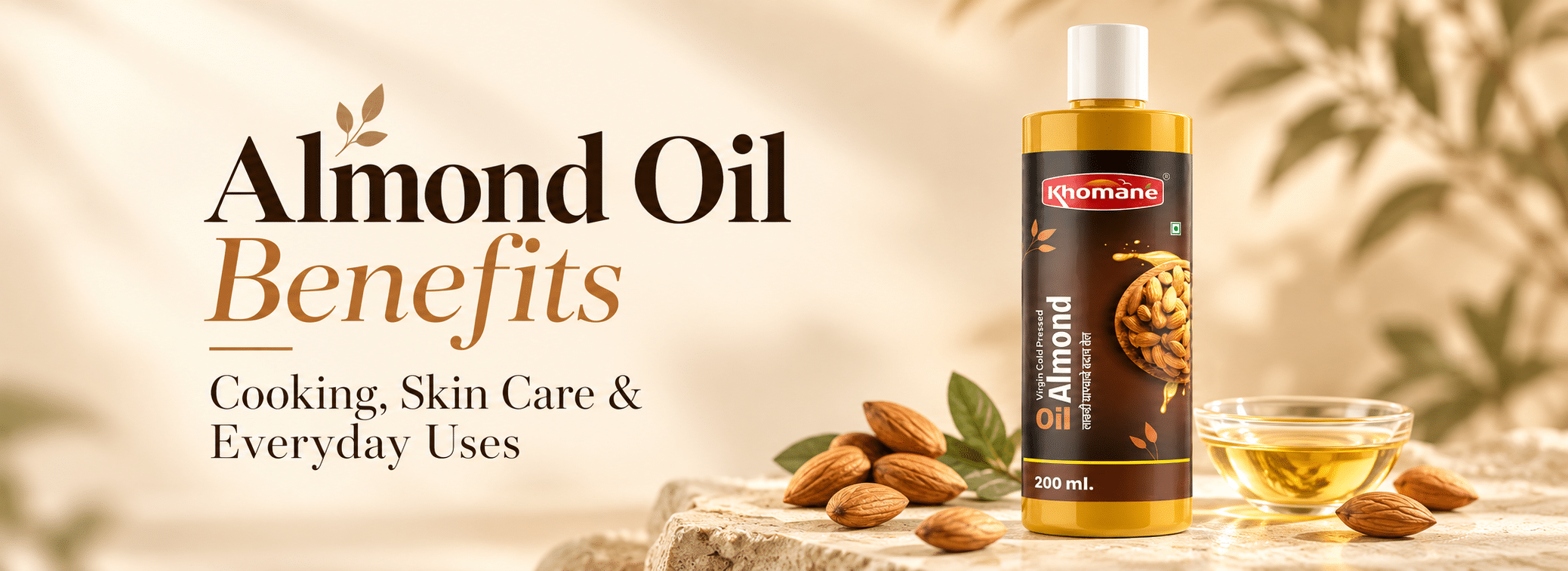
Almond oil benefits range from culinary versatility to skin and hair care, depending on the type and intended use of the oil. Food-grade almond oil can be used in selected dishes, dressings and low-heat preparations, while suitable cosmetic-grade or multipurpose almond oil is commonly used for moisturising skin, massage, hair care and dry cuticles.
Its mild aroma, smooth texture and naturally occurring fatty acids make almond oil one of the most versatile oils used in everyday routines.
However, not every bottle of almond oil should automatically be used for both eating and skin care.
The most important rule is simple:
Use almond oil for cooking only when the product is clearly labelled as edible or food-grade, and use it topically according to the manufacturer’s directions.
If you are exploring cold-pressed almond oil, this guide explains its uses, potential benefits, storage tips and how to choose the right product for your routine.
Quick Answer: What Are the Main Almond Oil Benefits?
The main almond oil benefits are its versatility and naturally smooth texture.
Depending on the product, almond oil may be used for cooking, salad dressings, skin moisturising, hair care, body massage and cuticle care.
Cold-pressed almond oil is produced with minimal heat compared with many heavily refined oils, which helps preserve more of the oil’s natural flavour and characteristics.
For culinary use, choose almond oil specifically labelled for food consumption.
For skin and hair, follow the product instructions and perform a patch test if you have sensitive skin.
What Is Almond Oil?
Almond oil is produced from almonds by extracting the naturally occurring oil contained in the kernels.
Two terms are commonly encountered when buying almond oil:
Sweet almond oil is the type most commonly associated with culinary and cosmetic applications.
Bitter almond oil is different and should not be confused with ordinary edible sweet almond oil.
When shopping for an almond oil product, always check the label rather than assuming that every almond-derived oil is suitable for the same purpose.
The extraction process also matters.
Cold pressing uses mechanical pressure with relatively low heat, while refined oils may undergo additional processing.
That is why many consumers searching for pure almond oil or cold-pressed almond oil prefer minimally processed varieties.
Cold-Pressed Almond Oil Benefits
Cold-pressed almond oil is popular among consumers looking for an oil with less intensive processing.
The main advantage of cold pressing is not that it turns almond oil into a medicine or automatically makes it healthier than every other oil.
Rather, it helps retain more of the oil’s natural flavour, aroma and characteristics.
Cold-pressed almond oil typically has a mild nutty profile, which makes it useful in dishes where you want subtle almond flavour without overpowering the other ingredients.
For topical use, its light texture can also make it comfortable for many people to apply to the skin or hair.
Almond Oil Benefits for Cooking
One of the most useful almond oil benefits is its culinary versatility when you are using an edible, food-grade product.
Almond oil has a mild, slightly nutty flavour that can work well in several types of recipes.
It is particularly useful when you want to add richness without introducing a very strong oil flavour.
Almond Oil for Salad Dressings
Food-grade almond oil can work well in homemade dressings.
Its subtle nutty character pairs with ingredients such as lemon, herbs, vinegar and mild spices.
You can combine it with other oils or use a small quantity as part of a vinaigrette.
Almond Oil as a Finishing Oil
A small drizzle of almond oil can add flavour to finished dishes.
Depending on the recipe, it may work with vegetables, salads, soups, grain bowls or selected desserts.
Using it as a finishing oil also allows its natural flavour to remain more noticeable.
Almond Oil in Baking
Edible almond oil may be used in certain baking recipes where a mild nutty flavour complements the dish.
It can work particularly well in cakes, muffins and selected desserts.
However, substitutions in baking depend on the recipe, so almond oil should not automatically replace every fat in the same quantity.
Almond Oil for Light Cooking
Some food-grade almond oils may be suitable for gentle or low-to-moderate heat cooking.
Always follow the manufacturer’s directions because the recommended cooking use can vary depending on whether the oil is cold-pressed, refined or specifically formulated for culinary purposes.
What Nutrients Are Naturally Present in Almond Oil?
Almond oil is mainly composed of fat, including a high proportion of monounsaturated fatty acids.
It also naturally contains vitamin E, although the exact amount depends on the oil, processing method and product.
These characteristics are one reason almond oil is widely used in food and personal-care routines.
However, almond oil remains calorie-dense like other edible oils.
The best approach is to use it as part of an overall balanced diet rather than treating it as a therapeutic food or consuming excessive amounts for supposed health benefits.
Almond Oil Benefits for Skin
Another common reason people search for almond oil benefits is skin care.
Suitable almond oil is often used as an emollient, meaning it can help soften and smooth the skin’s surface.
Its lightweight feel makes it attractive to people who prefer simple oil-based moisturising routines.
Almond Oil for Dry Skin
Applying a small amount of almond oil to dry areas may help reduce the feeling of roughness by creating a soft, moisturising layer on the skin.
It can be particularly useful on areas such as:
Dry elbows, hands, knees, feet and other areas that tend to lose moisture.
For best results, many people apply body oil while the skin is still slightly damp after bathing.
Almond Oil as a Body Oil
Almond oil can be used as part of a basic body-care routine.
After showering, applying a small quantity to damp skin can help support a softer, smoother feel.
A little usually goes a long way, so there is no need to apply excessive amounts.
Almond Oil for Facial Use
Some people use almond oil as a facial oil, particularly when their skin feels dry.
However, facial skin varies significantly between individuals.
If you have acne-prone, sensitive or reactive skin, patch-test the product first and stop using it if irritation develops.
People with persistent skin problems should follow advice from a qualified healthcare or dermatology professional rather than relying on almond oil as treatment.
Can Almond Oil Be Used as a Makeup Remover?
Suitable almond oil can help loosen certain oil-soluble makeup products.
A small quantity may be gently massaged onto the skin before cleansing.
However, it should not be used aggressively around the eyes, and you should follow the instructions provided for the specific product.
If a product is intended only for culinary use, do not automatically assume that the manufacturer recommends it as an eye-area cosmetic product.
Almond Oil Benefits for Hair
Almond oil is also commonly used in traditional hair-care routines.
Its main advantage is its ability to coat the hair and provide lubrication, which can make dry hair feel smoother and appear shinier.
Almond Oil for Dry Hair
A small amount can be applied to the lengths or ends of dry hair.
This may help improve the feel of rough strands and reduce the appearance of dryness.
Because almond oil can feel heavy if overused, begin with only a few drops.
Almond Oil for Scalp Massage
Some people use almond oil as part of a scalp massage routine.
Massage itself can be relaxing, while the oil provides slip and reduces friction between the fingers and scalp.
Almond oil should not be presented as a treatment for hair loss, dandruff or scalp disease without appropriate medical evidence.
If you have persistent scalp irritation or significant hair loss, professional advice is more appropriate.
Almond Oil Before Hair Washing
Another common method is to apply a small quantity to the hair before shampooing.
Leave it on for a short period and then wash normally.
This can be useful for people who want the conditioning feel of an oil without leaving it on their hair throughout the day.
Almond Oil for Massage
The smooth texture of almond oil makes it a popular base for massage.
It spreads easily across the skin and generally provides enough slip for a comfortable massage without needing very large quantities.
Some people also blend sweet almond oil with other suitable cosmetic oils.
If essential oils are being added, they should be diluted properly and used cautiously because concentrated essential oils can irritate the skin.
Almond Oil for Hands, Nails and Cuticles
Dry hands and cuticles are another everyday use for almond oil.
A small drop can be massaged into the cuticles and surrounding skin, particularly after hand washing or before bed.
This can help soften the area and improve the appearance of dryness.
Again, this is primarily a moisturising use rather than a treatment for nail disorders.
Almond Oil for Everyday Body Care
One reason almond oil remains popular is that one suitable product can fit into several simple routines.
Depending on the label and intended use, almond oil may be used for body moisturising, hand care, cuticle care, massage, hair conditioning or culinary purposes.
That versatility can make it appealing to consumers who prefer multipurpose household products.
However, always distinguish between food-grade and cosmetic-only almond oil.
A bottle sold for external use should not be consumed simply because almond oil itself can also be a culinary ingredient.
Food-Grade Almond Oil vs Cosmetic Almond Oil
This distinction is important for both consumer safety and accurate product communication.
Food-grade almond oil is produced and labelled for consumption.
Cosmetic almond oil is intended for external applications such as skin, massage or hair care.
Some products may be marketed for multiple uses, but this should be clearly stated by the manufacturer.
When considering almond oil for cooking and personal care, check the package for:
- Intended use
- Ingredient information
- Extraction method
- Storage instructions
- Best-before information
- Manufacturer directions
- Allergen information
This is more reliable than assuming that all cold-pressed almond oils are interchangeable.
How to Choose a Good Cold-Pressed Almond Oil
When shopping for cold-pressed almond oil, pay attention to the information on the bottle rather than relying only on marketing terms.
Choose a product whose intended use matches your requirements.
If you need almond oil for cooking, make sure it is clearly labelled as edible.
If you plan to use it for skin or hair, confirm that the product is intended or suitable for topical application.
Cold-pressed extraction may appeal to consumers seeking less heavily processed oils, but quality also depends on raw materials, handling, packaging and storage.
How Should Almond Oil Be Stored?
Proper storage can help preserve the flavour and quality of almond oil.
Keep the bottle tightly closed and away from direct sunlight, high heat and unnecessary exposure to air.
A cool, dark storage location is generally suitable, although you should always follow the storage instructions printed on the product.
Before using almond oil, check for unexpected changes in smell, appearance or flavour.
Always follow the manufacturer’s best-before recommendations rather than assuming the oil will remain fresh indefinitely.
Who Should Be Careful When Using Almond Oil?
People with almond or tree-nut allergies should be particularly careful with almond-derived products.
Food allergies can be serious.
Anyone with a known allergy should check product labels carefully and follow advice from their healthcare professional.
For topical use, a small patch test is a sensible precaution, especially for people with sensitive skin.
Discontinue use if redness, itching, swelling or other irritation develops.
Is Almond Oil Better Than Other Oils?
There is no single oil that is automatically the best choice for every person and every purpose.
Almond oil has advantages such as a mild flavour, smooth texture and versatility, but other oils may be better suited to different cooking temperatures, recipes, budgets or skin types.
The better question is:
What do you want to use the oil for?
For a mild finishing oil, selected recipes or multipurpose personal-care routines, almond oil can be useful.
For high-heat cooking or specific nutritional requirements, another oil may be more appropriate depending on the product and application.
How Can Almond Oil Fit Into an Indian Household?
Almonds have a familiar place in Indian food traditions, and almond oil provides another way to incorporate their characteristic flavour and texture into selected routines.
In the kitchen, edible almond oil can be explored for dressings, finishing and appropriate cooking applications.
For personal care, suitable almond oil may be used for hair oiling, body massage and moisturising.
This versatility is particularly relevant to consumers looking for cold-pressed oils in India that can fit into simple household routines.
Khomane Agro Cold-Pressed Almond Oil
For consumers exploring traditional and cold-pressed food products, Khomane Agro offers a range of products designed for everyday household use.
When considering Khomane Agro almond oil, check the individual product label or product page for its exact intended applications, ingredient information, storage instructions and whether it is approved for culinary, topical or multipurpose use.
This is especially important because claims such as “one oil for cooking, skin and hair” should only be made when the specific product is actually labelled for all of those uses.
Khomane Agro Farmer Producer Company Limited is based in Korhale Budruk, Baramati, Maharashtra, connecting the brand with Maharashtra’s agricultural and food-processing ecosystem.
Frequently Asked Questions About Almond Oil Benefits
What are the main almond oil benefits?
Almond oil is valued for its versatility. Depending on the product, it may be used as an edible oil in selected recipes or externally for moisturising skin, conditioning hair, massage and cuticle care.
Can almond oil be used for cooking?
Yes, but only when the almond oil is clearly labelled as edible or food-grade. Always follow the manufacturer’s cooking recommendations.
Can almond oil be applied directly to the skin?
Suitable cosmetic or multipurpose almond oil can generally be applied in small quantities to the skin. Patch-test first if your skin is sensitive.
Is almond oil good for dry skin?
Almond oil can work as an emollient that helps soften and moisturise dry-feeling skin. It should not be treated as a medical treatment for skin disease.
Can almond oil be used on hair?
Yes, suitable almond oil is commonly used on hair to improve lubrication, softness and shine. Apply a small quantity to avoid making the hair excessively oily.
Can almond oil help hair grow faster?
There is not enough evidence to claim that ordinary topical almond oil directly causes significant hair growth. It is better positioned as a conditioning and hair-care oil.
Can almond oil be used for massage?
Yes. Its smooth consistency makes suitable sweet almond oil a commonly used massage base.
Is cold-pressed almond oil better?
Cold pressing involves less intensive processing and can help preserve more of the oil’s natural flavour and characteristics. Whether it is the better choice depends on how you plan to use it.
Can I use the same almond oil for cooking and skin care?
Only if the specific manufacturer clearly states that the product is suitable for both purposes. Do not assume every edible oil is intended for cosmetic use or every cosmetic almond oil is safe to consume.
How should cold-pressed almond oil be stored?
Keep it tightly sealed in a cool, dark place away from direct sunlight and heat, and follow the storage instructions on the package.
Who should avoid almond oil?
People with known almond or tree-nut allergies should use caution and follow medical advice. For topical application, discontinue use if irritation occurs.
Where can I buy cold-pressed almond oil online in India?
Consumers looking for almond oil and other traditional food products can explore the available product range at Khomane Agro’s official website, khomaneagro.com.
Make Almond Oil Part of a Simple Everyday Routine
The real value behind almond oil benefits is versatility.
Food-grade almond oil can bring mild nutty character to selected recipes, dressings and finishing applications.
Suitable topical almond oil can provide a straightforward option for moisturising skin, conditioning dry hair, massage and cuticle care.
Rather than viewing almond oil as a miracle product, use it for what it does well: providing a versatile oil with a smooth texture, subtle flavour and multiple practical applications.
The most important step is choosing the right product for the intended use.
Check whether it is edible, topical or multipurpose. Read the label. Follow storage instructions. Use sensible quantities.
For consumers searching for cold-pressed almond oil, pure almond oil, almond oil for cooking or almond oil online in India, Khomane Agro provides another option to explore as part of its food and traditional product range.
Explore Khomane Agro
Khomane Agro Farmer Producer Company Limited
Gat No. 498, Korhale Budruk, Baramati, Maharashtra – 412103
Phone: 087673 06068
Email: khomaneagrofpc@gmail.com
Website: khomaneagro.com
Explore Khomane Agro’s product range and choose products according to their intended culinary or personal-care use.