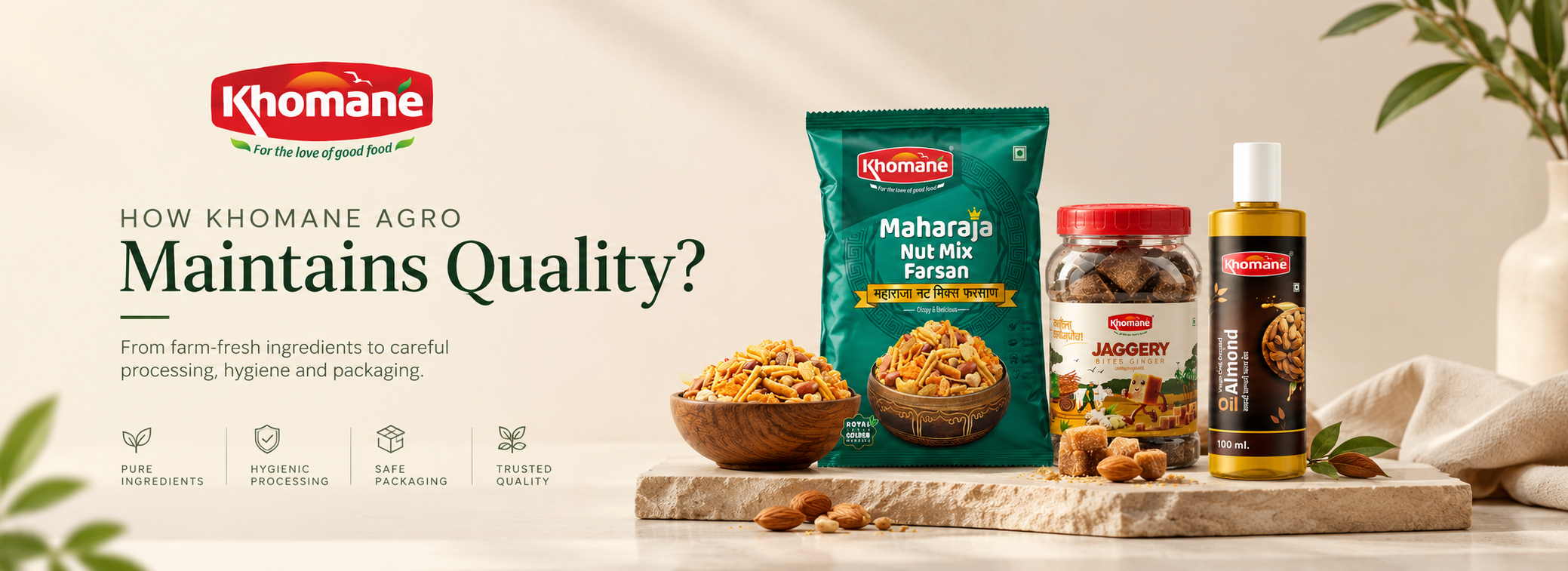
how Khomane Agro maintains quality? Quality starts with selecting suitable agricultural raw materials and continues through product-specific processing, hygiene, packaging, storage and customer guidance. Each stage plays an important role in preserving the expected flavour, texture and overall condition of food products.
Khomane Agro Farmer Producer Company Limited is a farmer-led food brand based in Baramati, Maharashtra. Its product range includes cold-pressed oils, jaggery products, spices, chutneys, traditional snacks and cow ghee. The company communicates a focus on hygiene standards and Good Manufacturing Practices (GMP) to support food quality and consistency.
From agricultural ingredients to the final sealed pack, understanding the Khomane Agro quality process helps consumers make informed choices about traditional Indian food products.
What Is the Khomane Agro Quality Process?
The Khomane Agro quality process can be understood through six important stages: raw material selection, cleaning and handling, product-specific processing, hygiene management, packaging and storage.
These stages help explain how food quality is managed from the beginning of production to the point at which a product reaches the customer. The exact procedures differ depending on whether the product is cold-pressed oil, jaggery, spices or farsan.
1. Raw Material Selection: Where Food Quality Begins
Raw material quality directly influences the flavour, aroma, texture and suitability of the finished product. Agricultural ingredients naturally vary according to crop variety, growing conditions, maturity, harvesting and storage.
As a farmer-led food brand connected with Maharashtra’s agricultural sector, Khomane Agro brings farm-related products closer to consumers through its range of traditional foods.
Selecting Ingredients for Their Intended Use
Different products require different ingredients and evaluation criteria. Groundnuts used for oil production, sugarcane-derived ingredients used for jaggery, spices used in masala blends and ingredients used in farsan cannot all be assessed in the same way.
Responsible raw material selection generally considers:
- Appearance and characteristic aroma
- Cleanliness and visible foreign matter
- Moisture condition
- Maturity and suitability for processing
- Signs of spoilage or pest damage
- Suitability for the intended product
- Supplier and batch information, where applicable
Selecting ingredients according to their intended use helps establish the foundation for consistent food quality.
Why Proper Storage of Raw Materials Matters
Even suitable agricultural ingredients can deteriorate when exposed to excessive moisture, heat, pests or unsuitable storage conditions.
Clean storage areas, appropriate containers and orderly stock rotation help protect ingredients before processing. Managing these factors is particularly important for seeds, nuts and spices, where changes in storage conditions can affect aroma, flavour and processing performance.
2. Cold-Pressed Oil Quality at Khomane Agro
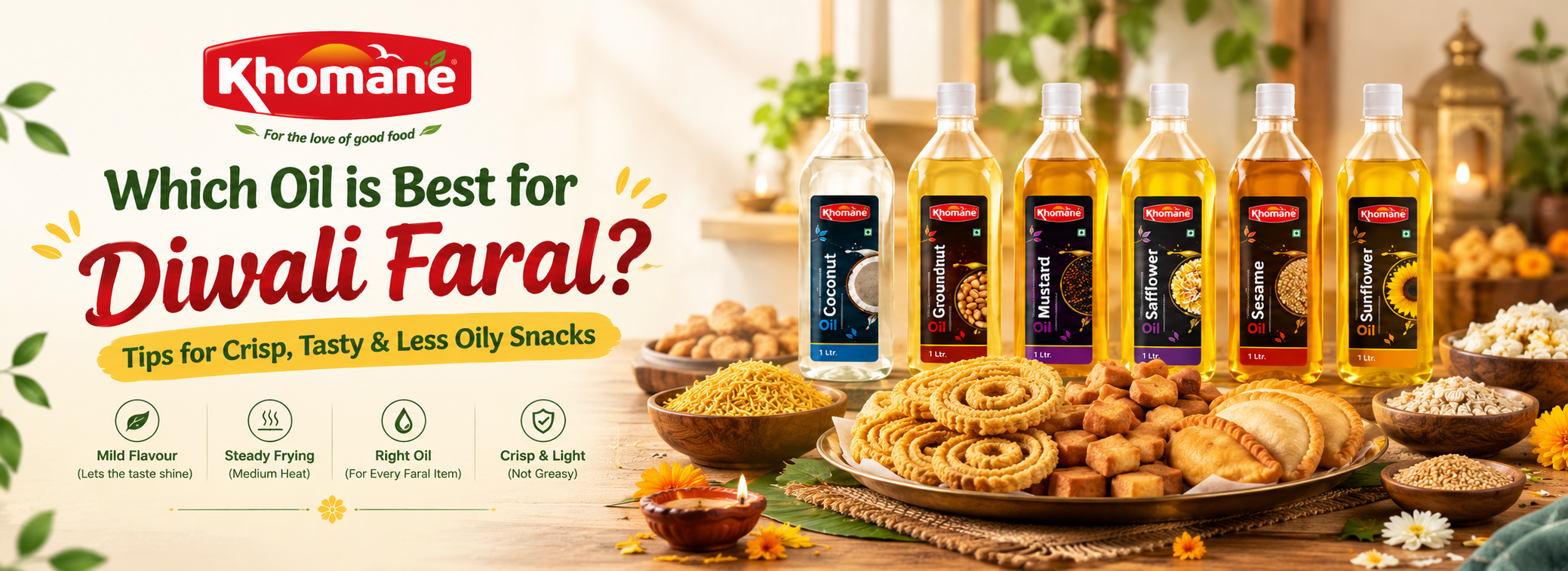
Khomane Agro offers a range of cold-pressed oils, including groundnut, sunflower, mustard, coconut, safflower and white sesame oil.
Cold-pressed oil is extracted using mechanical pressure rather than the intensive refining processes associated with many refined oils. The characteristics of the seeds or nuts, extraction method, handling and storage can influence the final oil.
How Raw Materials Influence Oil Quality
The quality of groundnut oil, sesame oil, mustard oil and other cold-pressed oils begins with the condition of the seeds or nuts used for extraction.
Suitable ingredients and appropriate storage help preserve their characteristic properties before processing. Different oil varieties naturally have different colours, aromas and flavours, so consistency does not necessarily mean that every variety should look or taste identical.
Understanding Sediment in Cold-Pressed Oil
Some minimally processed oils may contain fine particles that settle at the bottom of the container. Sediment alone does not necessarily indicate poor quality, but its presence should be considered alongside the product’s overall condition.
Customers should check the oil’s aroma, packaging integrity, label, best-before date and storage history. Unexpected odours, leakage, signs of contamination or other unusual changes should not automatically be dismissed as natural variation.
Filtration, Packaging and Storage
Appropriate filtration can help remove unwanted particles, depending on the product and processing method. Oil must also be transferred into suitable food-grade packaging and sealed properly to help prevent leakage and contamination.
To maintain cold-pressed oil quality after purchase, consumers should close the bottle securely, protect it from direct sunlight and follow the storage instructions on the label.
3. Jaggery Quality: Preserving Traditional Taste and Texture
Jaggery is a traditional sweetener valued for its distinctive flavour and versatility in Indian cooking. Khomane Agro offers traditional jaggery and other jaggery-based products, including jaggery powder, jaggery tea, jaggery coffee and flavoured jaggery bites.
What Influences Jaggery Quality?
Jaggery quality depends on several factors, including the raw material, preparation, moisture content, cooling and storage conditions.
Natural differences may occur in:
- Colour and shade
- Firmness and texture
- Aroma and flavour
- Granulation
- Dissolving characteristics
- Response to humidity
A darker or lighter shade alone does not establish whether jaggery is better or worse. Its overall condition, packaging, aroma, taste and product information should be considered together.
Why Moisture Protection Is Important for Jaggery
Jaggery can absorb moisture from its surroundings, particularly in humid conditions. Excess moisture may cause it to soften, become sticky or develop undesirable changes during storage.
Suitable packaging and dry storage help preserve its expected texture. After opening a pack, consumers should close it properly and follow the storage directions provided by the manufacturer.
4. Spice and Chutney Quality: Protecting Aroma and Flavour
Spices and chutneys are essential components of traditional Indian cooking. Their quality depends on ingredient selection, cleanliness, flavour balance, preparation and protection from moisture.
Khomane Agro’s range includes regional spice blends such as goda masala, garam masala, misal masala and kanda lasun masala, alongside other products designed for everyday cooking.
Maintaining Consistency in Spice Blends
Every spice contributes a different flavour and aroma to a masala. A recognisable blend depends on the appropriate selection and proportioning of ingredients.
Important considerations in spice production include:
- Ingredient quality and cleanliness
- Accurate formulation and proportioning
- Suitable grinding and mixing
- Aroma and flavour balance
- Protection against moisture
- Appropriate packaging
Agricultural ingredients may show natural variation between batches. Careful formulation and handling help maintain the intended character of the finished blend.
How to Protect Spice Aroma After Opening
Ground spices have more surface area exposed to air than whole spices. Over time, exposure to air, heat, light and moisture can reduce their aroma and flavour.
Consumers can help preserve spice quality by storing packs in a cool, dry place, using clean and dry spoons, and sealing containers immediately after use.
5. Farsan, Chiwda and Snack Quality
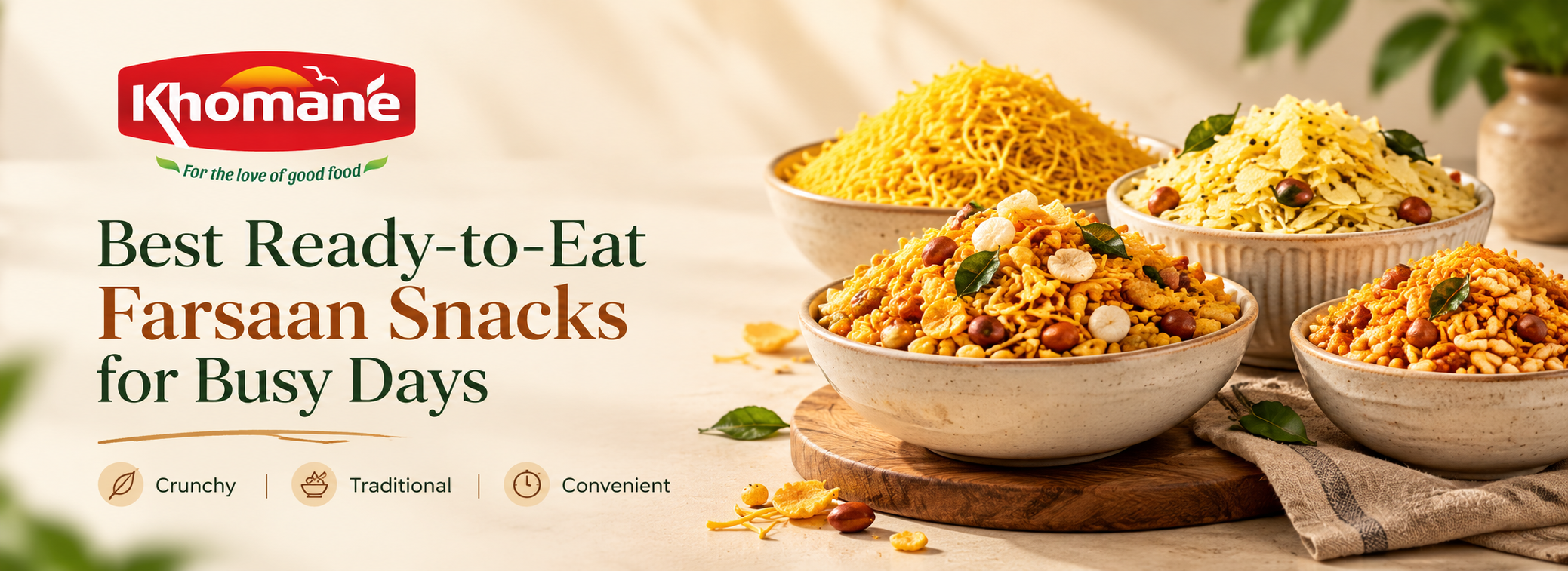
Traditional Indian snacks require attention to ingredients, cooking, seasoning, texture and packaging. Khomane Agro’s snack selection includes Navratna Farsan, Classic Mix Farsan, Special Farsan, Batata Chiwda and other traditional options.
Managing Ingredients and Texture
Farsan and chiwda mixtures may contain ingredients with different textures, shapes and preparation requirements. Their overall quality depends on how these components work together in the finished product.
Important factors in snack production generally include ingredient condition, cooking consistency, oil quality, spice distribution and texture.
Appropriate handling also helps prevent unwanted contamination during processing and packing.
Why Snacks Should Cool Before Packaging
Cooling snacks appropriately before packaging is an important food-handling principle. If warm snacks are sealed while releasing steam, trapped moisture may affect crispness and storage quality.
Suitable packaging helps protect the finished product from moisture and physical damage. Once a packet is opened, consumers should reseal it promptly or transfer the contents to a clean, dry, airtight, food-grade container.
6. Food Hygiene and Good Manufacturing Practices
Food hygiene is an important part of maintaining product quality. Khomane Agro states that it follows hygiene standards and Good Manufacturing Practices to support quality and consistency.
Good Manufacturing Practices, commonly called GMP, refer to procedures and controls designed to support hygienic and orderly food production.
Why Hygiene Matters at Every Stage
Food may be exposed to contamination during ingredient handling, processing, equipment use, transfer, packaging or storage. Hygiene therefore needs attention throughout the production process, not only during the final inspection.
Good manufacturing practices generally cover areas such as:
- Personal hygiene and appropriate handling practices
- Cleaning of equipment and food-contact surfaces
- Pest management
- Water quality, where applicable
- Waste handling and disposal
- Separation of raw materials and finished products
- Suitable storage conditions
- Cleaning schedules and process records
- Packaging and product-handling controls
The specific controls depend on the product, manufacturing facility and applicable food safety requirements.
7. Hygienic Food Packaging: Protecting the Final Product
Packaging serves a practical purpose beyond presentation. It helps protect food against environmental exposure, moisture, dust, physical damage and leakage.
Different food products require packaging suited to their characteristics. Oil requires leak-resistant containers, spices benefit from effective moisture protection, and snacks need packaging that helps preserve their texture.
What Should Be Checked Before a Product Is Packed?
Packaging checks can help identify visible issues before a product is dispatched. Depending on the product, these checks may include:
- Seal integrity
- Leakage or visible damage
- Correct product identification
- Accurate net quantity
- Clear batch identification
- Manufacturing and best-before details
- Appropriate label information
- Clean external packaging
These checks support the broader objective of delivering a properly identified and suitably packed food product.
Why Food Labels Matter
Food labels help consumers understand a product’s identity, ingredients and handling requirements. Depending on applicable regulations and the product category, labels may include:
- Product name
- Ingredient list
- Allergen declaration
- Nutritional information
- Net quantity
- Batch or lot number
- Manufacturing and best-before or expiry information, as applicable
- Storage instructions
- Manufacturer or marketer details
- Customer care information
Customers should read the product label before use and follow the stated storage instructions.
8. Traceability and Batch Consistency
Traceability helps identify and track products through relevant stages of production and distribution. Batch details can assist with investigating product-related concerns and identifying the affected product.
If a customer receives a damaged, leaking or unusual product, the batch number, purchase date and photographs of the packaging may help the company review the concern.
Consistency does not always mean identical colour, aroma or texture in every batch. Agricultural ingredients can vary naturally. The objective is to maintain the intended product characteristics while meeting applicable quality and food safety requirements.
9. How Customers Can Maintain Food Quality at Home
Food quality management continues after purchase. Proper storage and handling help preserve the condition of food products until they are used.
Customers can follow these practical steps:
- Check that the packaging seal is intact before opening.
- Read the ingredients, allergen information and storage instructions.
- Keep products away from direct sunlight and excessive heat.
- Protect moisture-sensitive products from humidity.
- Use clean, dry spoons when handling spices and jaggery.
- Close packets and containers immediately after use.
- Avoid mixing old and new products without checking their condition.
- Follow the recommended storage period and date information on the pack.
- Contact the seller or manufacturer if the product arrives damaged or shows unusual characteristics.
These practices help consumers make the most of their purchased products while reducing avoidable storage-related quality problems.
Frequently Asked Questions About Khomane Agro Quality
1. How does Khomane Agro maintain quality?
Khomane Agro describes its approach to food quality through farmer-connected sourcing, suitable raw materials, careful processing, hygiene standards, Good Manufacturing Practices, appropriate packaging and responsible storage. Specific processes may differ across its oil, jaggery, spice and snack products.
2. What products does Khomane Agro offer?
Khomane Agro offers a variety of traditional food products, including cold-pressed oils, jaggery products, spice blends, chutneys, farsan, chiwda and cow ghee. Customers can check the official website for the available product range and individual product details.
3. Why can cold-pressed oil contain sediment?
Fine particles may settle in some minimally processed oils, depending on the extraction and filtration method. Sediment alone does not establish whether an oil is safe or unsuitable. Customers should also assess the packaging, aroma, label and storage history, and contact the manufacturer if they notice unusual changes.
4. How can consumers check food packaging quality?
Consumers should check the seal, packaging condition, product name, net quantity, batch details and relevant date information. Oil bottles should not show leakage, and food packs should not have visible damage or signs of contamination.
5. How should Khomane Agro products be stored?
Storage requirements vary by product. In general, products should be kept in clean, suitable conditions away from excessive heat, direct sunlight and moisture. Always follow the storage instructions printed on the individual pack.
6. Does natural variation mean a food product has poor quality?
No. Agricultural products such as oils, jaggery and spices may naturally differ in colour, aroma, texture and other characteristics. However, unusual odours, visible contamination, damaged packaging or other abnormal changes should not be ignored.
7. Where can customers buy Khomane Agro products?
Customers can explore the available products through the official Khomane Agro website at https://khomaneagro.com/. The brand also indicates availability on Amazon India, subject to the current product listings.
From Responsible Sourcing to the Final Pack
How Khomane Agro maintains quality involves more than the finished product. Raw material selection, appropriate processing, food hygiene, packaging, storage and clear customer information all contribute to the overall quality journey.
Based in Baramati, Maharashtra, Khomane Agro Farmer Producer Company Limited connects traditional Indian food products with the needs of modern households through its range of cold-pressed oils, jaggery products, spices, chutneys, snacks and cow ghee.
Consumers can explore the product range, review individual ingredients and packaging information, and follow the recommended storage instructions when choosing food products for their homes.
Contact Khomane Agro
Business Name: Khomane Agro Farmer Producer Company Limited
Website: https://khomaneagro.com/
Call / WhatsApp: +91 87673 06068
Email: khomaneagrofpc@gmail.com
Address: Gat No. 498, Korhale Budruk, Baramati, Maharashtra 412103, India
Online Availability: Amazon India, subject to current listings.
Explore Khomane Agro for traditional flavours and farmer-connected food products, with attention to product information, suitable handling and quality-conscious food choices.